In Toulouse, on the final assembly line where Airbus builds the A350, a software engineer spent his days watching fuselages come together. He wasn’t an Airbus employee. He was a Palantir Forward Deployed Engineer—a “Delta” in the company’s internal language—embedded inside the client’s operation, building production software on real data while standing next to the people who would use it. His peers were stationed in airgapped military facilities, on oil rigs, inside pharmaceutical clean rooms.
Not typical workplaces for software engineers. That was the point.
This is the model that built a $300 billion company. And it has almost nothing to do with the software itself. It has everything to do with where the people sit.
The Problem in the Gaps
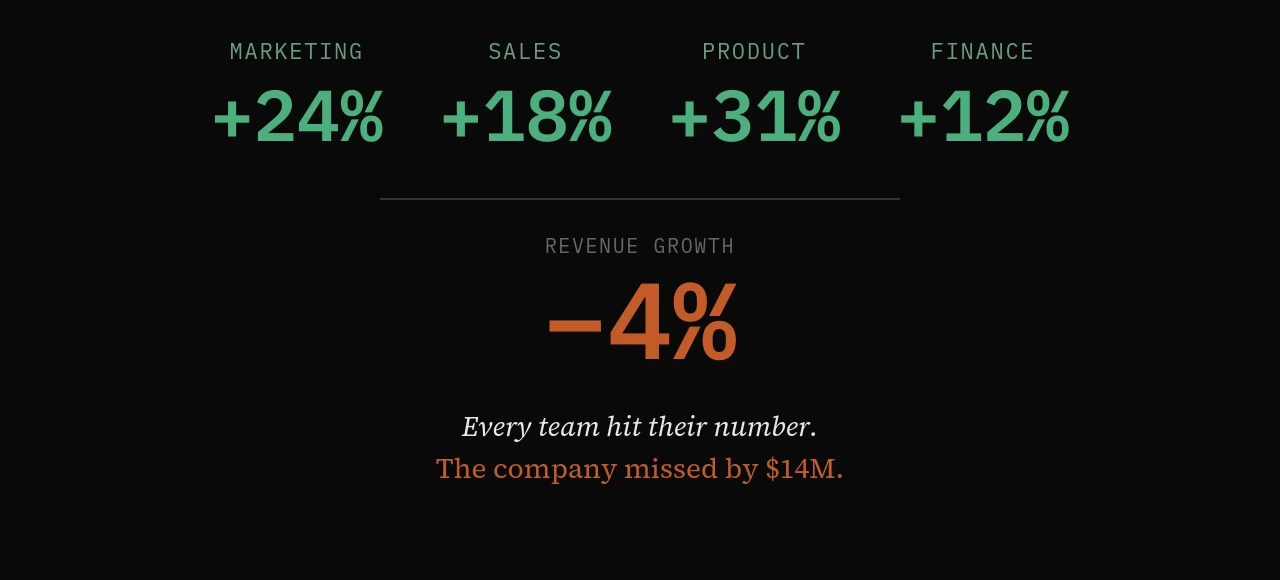
Look at the numbers at the top of this page. Four teams, four green metrics, all trending up. The company still missed by $14 million.
This isn’t a hypothetical. This is the pattern Palantir’s FDEs encounter in nearly every engagement. The reason it keeps happening isn’t incompetence. It’s architecture. The most expensive problems in any organization don’t belong to any team. They exist in the interstitial space between teams—between the way a company is structured and the way value actually flows through it. No single department owns them. No single leader has visibility into them. They persist because the organizational design itself creates the blind spots.
Traditional software can’t reach these problems—it’s built for departments. Consultants can’t reach them—they’re scoped to workstreams. The only way to see them is to sit inside the operation, with real authority, across the boundaries where value leaks out.
Inside the Machine
When a Palantir team drops into a new client, they aren’t building anything yet. They’re mapping the operation—tracing how data moves between systems, how decisions get made and by whom, where handoffs break down, and where resources flow versus where they actually produce returns. They sit in meetings they weren’t invited to. They pull reports nobody reads. They follow a decision from the moment someone proposes it to the moment it either succeeds or quietly dies.
The goal isn’t to understand what the client says their operation looks like. It’s to understand what it actually looks like.
The team doing this work is small and deliberately structured. “Echoes”—domain analysts who embed on-site to find the real high-leverage problems, the ones nobody has articulated because they live between departments. “Deltas”—the engineers who rapidly build and deploy solutions on Palantir’s platform, on real data, in production. And Deployment Strategists who bridge technology to operations and drive adoption across stakeholders. Small team. One customer. Full accountability for outcomes.
The critical ingredient most imitators miss is authority. Embedding without it is just observation. Palantir gave their field teams the mandate to make architectural decisions, push back on clients, redesign workflows on the fly. Internally, they described this as Auftragstaktik—the German military doctrine where senior leaders set the objective and field teams make every other decision. It’s anathema to most corporate cultures. But it’s what turns presence into value.
This is the inverse of the pattern most organizations run — where the people doing the work are structurally invisible to the people evaluating it.
Then comes the intervention. Not the kind consultants deliver—not a deck, not a set of recommendations. Palantir’s teams find the one broken pipeline, the one misrouted data flow, the one decision being made on bad assumptions—and fix it fast enough to demonstrate tangible value within days. This is the “bootcamp”: a rapid prototyping sprint on the client’s own data, producing working applications almost immediately. Not demo environments. Real systems on real operations.
The speed is strategic. Fast, visible wins earn the trust required for deeper systemic work.
At Airbus, the first engagement targeted a single problem: A350 production bottlenecks. The embedded team mapped how data moved between supply chain, scheduling, and manufacturing—then built a working integration that helped increase A350 production by 33%. That one win opened the door to more than twenty adjacent use cases. Today the platform those FDEs helped build—Skywise—serves over 50,000 daily users and more than 100 airlines. The first engagement lasted months. The relationship has lasted a decade.
Why Competitors Can’t Follow
The pattern is everywhere once you see it. A company hires a top consulting firm to diagnose fragmentation across supply chain and manufacturing. Eight months and several million dollars later, the deliverable is a 200-page roadmap. Eighteen months after that, the roadmap sits in a shared drive, unexecuted. The teams that were supposed to implement the recommendations never aligned on priorities. The diagnosis was accurate. But the consultants left before anything was built, and the ungoverned layer—the gap between the teams—was exactly where the recommendations went to die.
This is the structural failure the FDE model was designed to eliminate. The model requires a company to be excellent at three things simultaneously: deploying high-caliber people into client operations, building sophisticated tools they can use in the field, and maintaining the discipline to synthesize field learnings back into a scalable system.
Consulting firms have the talent but don’t embed long enough to build anything—they diagnose and leave. SaaS companies have the platform but their people sit in their own offices, not inside the client’s world. Agencies execute tactics but lack the authority or methodology to govern cross-functional decisions. Each model fails on a different requirement. Only the embedded operator clears all of them at once.
And the stickiness isn’t switching costs. Palantir’s contracts are sticky because their people are the ones who understand how the client’s operation actually works. Remove them and you don’t just lose a vendor. You lose the institutional memory of your own decision-making infrastructure.
It feels like consulting in its closeness to the client, but scales like software in its product-led DNA. That hybrid is the unlock. Neither consulting nor software alone can produce it.
A common critique is that the model is capital-intensive—that individual engagements must lose money before they pay off. Palantir’s own former CFO called applying it to small contracts “lighting equity on fire.” But this conflates the cost of the model with the cost of Palantir’s specific problem domain. Deploying into airgapped military networks and classified infrastructure carries enormous integration overhead. The embedded model itself doesn’t require it. In domains where the systems already exist and the decisions are already being made—just being made badly—the same approach works without the infrastructure friction.
The Compounding Machine
Here’s where the model gets dangerous for competitors.
Every engagement generates structured artifacts—not narrative trip reports but systematic records: which decisions were governed, what the predicted outcome was, what the actual outcome was, and what the delta reveals about the operating environment. This information flows back to Palantir’s product team not as anecdotes but as patterns—recurring failure modes, common gaps, decision categories that consistently produce waste across industries.
The platform itself was built this way. Palantir didn’t start as a $300 billion platform business. It started as a services-heavy operation where FDEs were the entire value proposition—small teams solving one hard problem at a time. Until 2016, there were more FDEs than software engineers. No platform moat yet. Just people sitting inside broken systems, building whatever it took.
The platform came from the field, not the other way around. Foundry’s core elements were first built in Zurich and Houston, São Paulo and Toulouse—FDEs hitting the same categories of problems across different clients and continents, gradually revealing which patterns were universal. Those patterns got abstracted into reusable capabilities. The bespoke work of early Deltas became the foundation for Gotham. Gotham informed Foundry. Foundry laid the groundwork for AIP, their AI platform.
The people made the software. The software then scaled what the people learned.
The COVID-19 pandemic proved what this compounding knowledge could do under pressure. When the U.S. government needed a system to coordinate vaccine distribution across fifty states, thousands of jurisdictions, and multiple manufacturers with conflicting cold-chain requirements, Palantir deployed Tiberius in six weeks. The platform integrated dozens of fragmented data sources—CDC case data, Census demographics, hospital capacity, freezer locations, manufacturer production estimates—into a single operating picture that federal and state officials used to allocate every dose. Over 100 organizations relied on it, including the UK’s National Health Service.
Six weeks. Because hundreds of prior engagements had already solved the underlying category of problem: unifying fragmented data across organizations that don’t share systems, vocabulary, or incentives.
Today the flywheel is visible in the numbers—$4.48 billion in 2025 revenue, Q4 growing 70% year over year, U.S. commercial revenue more than doubling. CEO Alex Karp calls it “N of 1.” To compete, you’d need to simultaneously build a world-class platform, recruit engineers willing to deploy into client operations for months, develop a methodology for governing decisions across functions, and create the feedback loop that turns field experience into scalable product.
Starting any one of those from scratch would take years. Starting all four would take a miracle.